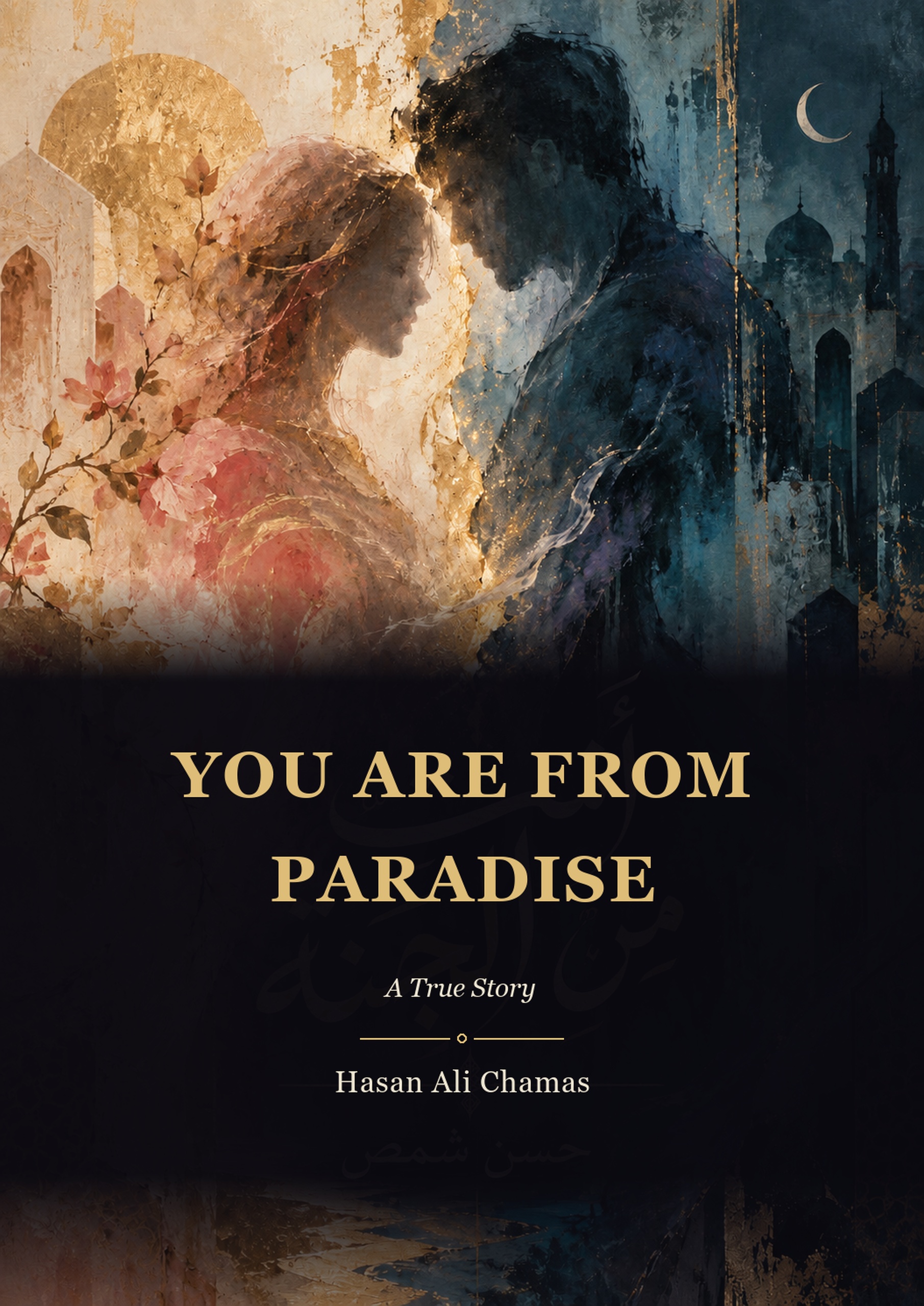
You Are From Paradise
A True Story
You Are From Paradise
A True Story
"You are from Paradise." Those were the first words a young Lebanese man ever spoke to the girl who would upend his life — a stranger he mistook for an angel in a university café in Bradford, England. He didn't know her name yet. He didn't know that this one unplanned sentence would become the title of the story you're about to read, or that it would turn out to be both a blessing and a curse.
This isn't a novel in the traditional sense, and it isn't a dry political memoir either. It's a full confession, written with a rawness that borders on painful, by a man who spent years deciding whether to open his heart to strangers at all — the story of how a single love collided with everything: religion, sectarianism, corrupt politics, the collapse of a homeland, and the questions of identity that follow anyone born into a fractured country who is simply trying to love freely.
From a Poor Beirut Suburb to the Halls of Bradford
Before readers meet Sara — the heroine of the story's first half — the author takes us back to his childhood in a poor neighborhood on the outskirts of southern Beirut, born in 1990 in the middle of Lebanon's civil war, to a carpenter father who clawed his way out of poverty "impossible to escape except by miracle," and a homemaker mother who dreamed her firstborn would one day be called "Doctor." From an Islamic school in Haret Hreik, to a furniture workshop where he spent his summers among sawdust and the voices of laborers, the author paints a precise portrait of an ordinary childhood in an extraordinary country.
Then comes the first turning point: acceptance into the Lebanese American University in 2008, where he steps for the first time out of his "small bubble" to meet students from every sect and background, against the backdrop of political turmoil that shook Lebanon between 2008 and 2011. Then the bigger leap: acceptance to the University of Bradford in the UK for his Master's in 2012, traveling alone at twenty-one, and suddenly finding himself in "a world far bigger than anything he'd ever experienced" — an international campus, students from every continent, languages and religions and stories he'd never encountered before.
In that new world, in one aimless conversation with three Arab friends in a university café, the story began.
Sara: The Girl Who "Knew Nothing About Lebanon," So Lebanon Introduced Her to Herself
His friend Mohammed pointed him toward two girls sitting behind the university steps, joking that as president of the Arab Student Forum, he owed it to himself to "know all the Arabs here." That moment — born from an offhand joke between young men — was the moment that changed the course of his entire life.
He asked her where she was from. She answered, in a soft voice: "I'm from Lebanon, but I don't know anything about Lebanon." So he said the line that would haunt him for years: "If you don't know it, Lebanon knows you. But you — you are from Paradise."
From that moment, a complicated, escalating relationship began with "Sara" — a Lebanese girl from a well-off family, four years younger, studying pharmacy, from a conservative Sunni family. And while he was Shia to his core, it never crossed his mind that this one religious detail, which seemed at first like a "silliness" not worth mentioning, would become the wall their relationship would eventually shatter against.
The author recounts, in intimate detail, how it all began: a university karaoke night where Sara sang a Celine Dion song, a first date walking in the rain to a Turkish restaurant, sneaking out of her own house "as if it were the gate of Paradise," a small stuffed bear gifted with a made-up story, and her first, sudden question that froze time in the restaurant: "Are you Sunni or Shia?"
One Question Opens a Wound a Thousand Years Old
From this moment, the book becomes something far deeper than a college romance. The author dismantles, with rare honesty, the entire sectarian discourse he grew up absorbing — the language of "us" and "them," of "our mosque," the language of mutual fear that politically serves sectarian leaders while ordinary people fight their wars for them.
He finds himself, the enthusiastic young man, waging a continuous "battle of persuasion": first with Sara herself, then with her mother Hanan in a moving first meeting that ends in her outward approval, then — hardest of all — with her father "Omar," a quiet, silent man with unreadable green eyes, who receives him at their home in Manchester with an ordinary handshake, but sends him off with an unexplainably tense grip — a grip whose meaning he only understands days later: an anonymous letter accusing him of being "a liar and a fraud."
The book later reveals, in a tone that mixes bitterness with dark comedy, that behind this letter — and much more that tried to sabotage the relationship — was an unexpected alliance among his own Arab "friends" at university, three young men who treated women as "spoils of war" and couldn't stand the thought of one of them winning what they hadn't — a scene that exposes, with rare boldness, a social and moral hypocrisy that goes far beyond this one story.
A Mother Unlike Other Mothers, and a Father Searching for an Enemy
One of the most complicated and strange threads in this book is the author's relationship with Sara's mother, "Hanan." A young girl waiting for him at the airport with her mother in the rain; a full week's worth of groceries brought to him every week; blankets and winter socks and boxes of chocolate — care that, by his own admission, exceeded even his own mother's, whom he'd left behind in Lebanon. But this excessive attention, which first felt like family warmth, gradually turns into something far more ambiguous: hours-long phone calls, an intrusion into the smallest details of the relationship, a bewildering contradiction between encouraging the relationship and undermining it at the same time — until Sara herself asks her boyfriend to limit his relationship with her own mother, because "something is wrong," something she can't quite explain.
By contrast, the author paints Sara's father, "Omar," with a rare, layered compassion: a man who isn't necessarily a villain, but a "victim of divisive media," who asks him out of nowhere what he thinks of the Syrian civil war just to place him in a predetermined box, takes him to "our mosque" in a silent attempt to "make him one of us," and stands, at the moment of final reckoning, to demand one decisive answer from his daughter — in front of everyone, in a hotel lobby in Beirut.
Beirut Burns Twice: Love in the Middle of a Collapse
The romantic storyline in this book intersects with an escalating political and social thread that documents a pivotal chapter in modern Lebanese history: from the 2015 "You Reek" campaign against the garbage crisis, where the author was one of the founders and key organizers, to his election as secretary-general of a newly formed opposition party called "Sabaa" (Seven), to the October 17, 2019 uprising against corruption and the political class, which erupted after the collapse of the Lebanese lira and the banks' failure to return people's deposits — and he was one of its direct victims.
This intersection between personal love and collective collapse is not narrative decoration — it is the heart of the book: how does a young man try to build a life and a love in the middle of a homeland collapsing beneath his feet, and how does his battle for one woman's heart become entangled with his battle for a country that refuses to change. In one of the book's most powerful scenes, the author receives a message from Sara that restores his hope at the exact moment he has lost faith in both his friends and his country — a message asking him to finally meet her mother.
The Moment of Truth: One Word Destroys Everything
After years of waiting, patience, and persuasion, the story reaches its climax in a scene readers won't easily forget: through a sudden arrangement by Sara's own mother, the author finds himself in a Beirut hotel lobby, sitting across from Sara's father, while she sits in silence, her eyes unblinking. The father asks his daughter, in front of everyone, for a direct answer.
Time stops. The author is certain of the answer, waiting for it like a man awaiting a verdict of innocence. But Sara, her voice trembling and her eyes full of tears, says only one word: "No."
What follows — Sara's frantic apology messages, attempts at reconciliation, a final meeting in the middle of a demonstration in downtown Beirut that ends with their hands intertwined amid the crowd before they're separated by tear gas canisters and riot police, in a scene that blends intimacy with political chaos unforgettably — none of it will be enough to turn back the clock.
An Ending That Doesn't Look Like Hollywood
In one of the book's most candid and literarily bold passages, the author pauses to directly address the reader: "Are you waiting for an ending embroidered with hope? Do you expect the pages of truth to suddenly turn into a rosy tale?... True stories are never concluded with absolute happiness, nor a resounding victory for the hero. Those scenes were born in the studios of Hollywood."
This book refuses, with full awareness, to offer the reader a manufactured happy ending. The author admits, with bitterness, that he is "the first defeated man who dares to write his own story," that Sara ultimately loved someone else, and that love — despite every battle of persuasion, philosophy, and politics he waged for it — did not defeat sectarianism this time.
But the story doesn't end there.
Nariman: The Real Story the Reader Was Waiting For
In a final narrative twist that rewrites the meaning of the entire book, the author reveals that the true "heroine" of this story is not Sara, but another woman he met later, in 2022, who carried the exact same religious and family challenge — a Sunni girl whose mother also opposed her marrying a Shia — but who, unlike Sara, did not break under the pressure. He describes her as "a fighter in the name of love," and says he was nothing but "the sole knight in her army," and that the meaning of her name — as she told him herself, laughing — is "queen."
With this final touch, the book transforms from an elegy for a failed love into a testament of hope: love does not always lose to bigotry, but it sometimes needs two people willing to fight the battle together, not one person fighting alone. "We have not won yet, but we have not been defeated either" — so the author closes his story, declaring that, to this day, he still stands in the same trench alongside Nariman.
Why This Book Is Worth Reading
This book is written with a rare honesty that makes the reader feel as though they're reading private letters never meant for them, not a carefully polished novel. It took nine full years to write, begun in 2015 as a direct reaction to his own love story, abandoned repeatedly between Beirut, Istanbul, and Manchester, before finally being completed from an apartment in Niagara Falls, Canada, in 2024, after he settled there as dean of a data science department — having left behind a homeland he departed only after it was exhausted by corruption and collapse.
This is a book about love, yes — but it is also a book about:
- Sectarianism as it is lived from the inside, not as it is discussed in news reports — with all its human complexity, without reducing either side to an absolute villain.
- Immigration, and what it means to leave a country you loved and fought to fix, only to start over somewhere that doesn't know your name.
- Ambiguous motherhood, through the character of Hanan, who remains one of the most puzzling and thought-provoking figures in the book.
- Eastern masculinity, whose contradictions the author dismantles with rare courage, admitting his own faults as openly as he exposes his society's.
- Lebanese politics, from the Cedar Revolution to the October uprising, documented from the position of a participant, not a distant observer.
- Delayed victory, which proves that the end of one story is not the end of the whole story.
Any reader who has ever loved and lost, or loved and triumphed against all odds, will find something of their own story in these pages. As the author himself says in his introduction: "Read my story... and perhaps you will find in it something of your own. That is my aim, and my intent."
"You Are From Paradise" — a true story, unvarnished, about love when it is fought in the name of religion, about religion when it is used to kill love, and about a man who refused, in the end, to let either one defeat him.